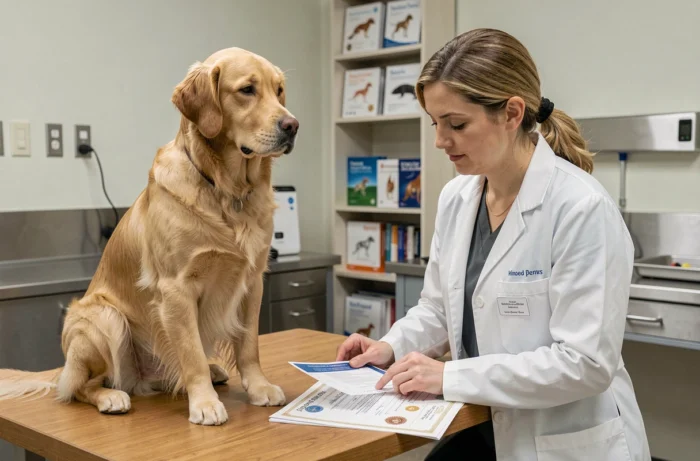
A dog that looks exactly like a German Shepherd is not necessarily a purebred dog in the legal sense. In France, a dog is officially considered a purebred dog only if it is registered in the French Stud Book (LOF), maintained by the Société Centrale Canine. Without this registration, the dog is legally considered to be “of” a particular breed, regardless of its appearance.
This distinction affects the purchase price, the documents provided by the breeder and the guarantees a prospective owner can expect. Understanding the difference between a purebred dog, a dog that looks like a particular breed and a pedigree helps avoid costly misunderstandings.
Documents to ask the breeder for before buying a purebred dog
The listing says “purebred” or “LOF.” Those words alone are not enough. Before paying, you should be shown several documents, each of which proves something specific.
- The LOF birth certificate confirms that the litter was registered with the Société Centrale Canine and that both parents are registered too. This document is provisional; it is not a final pedigree.
- The sales contract must state the breed, identification number (microchip or tattoo), LOF registration number and price. If “LOF” is not mentioned in the contract, the dog cannot be sold as a purebred, even if the listing claimed otherwise.
- Health test results for the parents (hip dysplasia, eye conditions and DNA tests, depending on the breed) are not always mandatory, but a responsible breeder will provide them without being asked. A pedigree traces lineage, not health.
- The health record or European pet passport, showing up-to-date vaccinations and parasite treatment, completes the paperwork but is not directly related to the dog’s breed status.
A seller who refuses to show you the LOF birth certificate before the sale is, at best, selling a dog that merely looks like a particular breed. Without LOF documentation, the dog is not legally considered purebred.
To understand a dog’s pedigree and what it means in practice, it is important to distinguish between two administrative steps that are often confused.

LOF registration and final pedigree: two separate steps
Many prospective owners think a puppy receives its pedigree at birth. That is not the case. LOF registration and the final pedigree are two separate procedures.
At birth, the breeder registers the litter. If the parents are registered with the LOF, the puppies receive provisional birth certificates. These certificates make them eligible for a pedigree, but are not a substitute for one.
Confirmation when the dog is fully grown
The final pedigree is issued after a procedure known as confirmation. Once the dog is an adult, a judge examines it at an official session. The judge checks that the dog meets its breed’s physical standard (proportions, coat, gait and teeth).
The minimum age for confirmation varies by breed. If the dog does not pass, it remains provisionally registered with the LOF but does not receive a final pedigree. It cannot produce puppies that are eligible for LOF registration.
For prospective owners who do not plan to breed their dog, confirmation is optional. The LOF birth certificate is enough to prove the dog’s breed status in everyday situations, for pet insurance or access to certain activities.
Purebred, breed-type and mixed-breed dogs: three statuses not to confuse
The most common source of confusion is the term “breed-type.” A poodle that is not registered with the LOF may look and behave like a poodle, but it cannot be sold as a “poodle” without being described as “poodle-type.”
What each status means in everyday life
A dog registered with the LOF has a documented pedigree spanning several generations. This recorded lineage can help identify potential health and temperament predispositions, provided the information is considered alongside tests carried out on the bloodlines.
A breed-type dog looks like a particular breed but has no official registration to confirm it. Its behaviour and health still depend on its individual genetics and breeding conditions, but it has no verifiable family tree.
A mixed-breed dog combines traits from several breeds or bloodlines. The widespread belief that mixed-breed dogs are always healthier is not an absolute rule. A dog’s health depends more on the selection of breeding dogs than on its breed status.
Pedigree and puppy health: what the document proves—and what it doesn’t
A pedigree is a certified family tree. It lists ancestors across several generations, any titles they may have earned in shows or working competitions, and their identification numbers. It is a traceability tool, not a health certificate.
A pedigree guarantees neither a dog’s health nor its temperament. Two show champions can produce a puppy with a genetic disorder if no screening has been carried out. Conversely, a responsible breeder who routinely tests breeding dogs offers better assurances, with or without a pedigree.
What to check beyond the pedigree
Relevant health tests vary by breed. For a German Shepherd, hip X-rays to check for dysplasia are among the standard checks. For a Cavalier King Charles Spaniel, heart screening is a priority.
- Ask for the parents’ screening results, not just their pedigrees
- Check whether the breeder belongs to a breed club that requires health protocols
- Ask about the puppy’s socialisation during its first weeks of life, a key factor in its adult behaviour
A pedigree remains a valuable document when choosing a puppy with care. It lets you trace bloodlines and identify any recurring problems. Combined with health tests, it provides the foundation for an informed adoption.
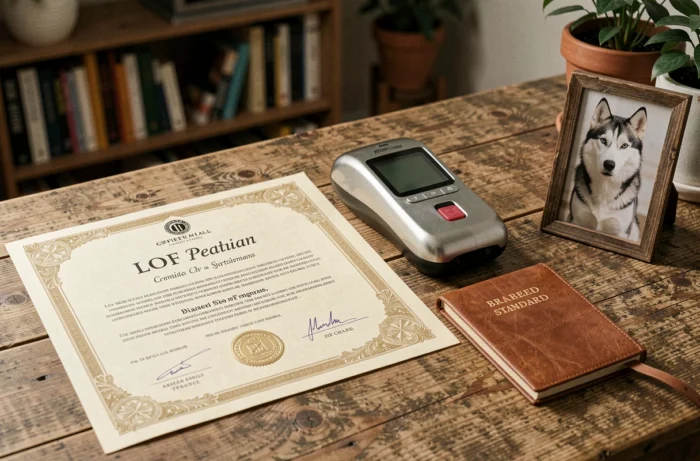
A dog’s official status says nothing about its ability to become a good companion. A breed-type or mixed-breed dog can be perfectly suited to life in a house or an apartment. What matters is whether the dog’s temperament matches its owner’s lifestyle. Checking the documents before buying mainly protects you from scams and false promises—not from choosing a dog with the wrong temperament.