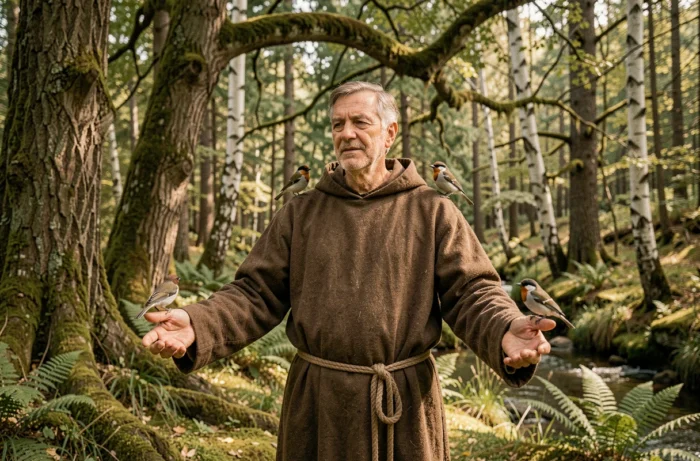
Francis of Assisi remains the most documented figure among the saints associated with communication with animals. However, reducing this connection to a mere pious anecdote overlooks a dense hagiographic corpus, structured around specific episodes that have nourished the theology of Creation for eight centuries.
Theology of Cosmic Brotherhood in Francis of Assisi
Francis of Assisi did not “speak” to animals in the vernacular sense. He integrated them into a theological vision where each creature participated in divine praise. This stance is based on the concept of cosmic brotherhood, articulated in the Canticle of Creatures, where the sun, the wolf, and the bird receive the title of “brother” or “sister.”
This framework is not metaphorical. For the Franciscan order, Francis’s relationship with animals stems from a literal reading of Creation as a divine gift. The birds that gathered around him without fear, the fish he blessed, the wolf of Gubbio that he supposedly calmed with words: each episode illustrates an embodied theology, not a shamanic gift.
We observe that the earliest hagiographic accounts, notably the Fioretti, clearly distinguish the preaching to animals (an act of faith) from animal communication as understood today. Francis preached to the birds as he preached to men, without any ontological hierarchy between the recipients. The tradition that makes him the saint who communicated with animals is rooted in this absence of separation between human and non-human life.
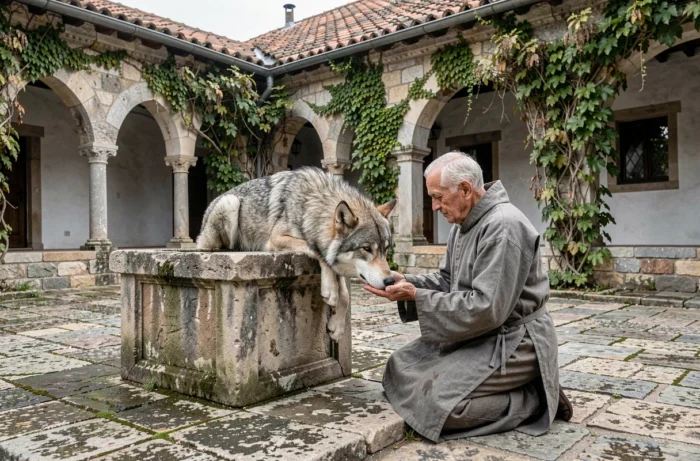
The Wolf of Gubbio: Foundational Narrative and Critical Reading
The episode of the wolf of Gubbio concentrates the majority of modern projections on Francis of Assisi. A wolf terrorizes the town, Francis goes to meet it, speaks to it, and obtains a pact: the wolf ceases its attacks, and the townspeople feed it.
This account appears in the Fioretti, written more than a century after Francis’s death. It is not found in the early biographies of Thomas of Celano. This temporal distance raises a source problem that popular articles systematically ignore.
The wolf of Gubbio functions as a parable of reconciliation between man and the wild nature. Whether the event is historical or allegorical, its theological significance remains the same: the saint’s word restores an order broken by both human and animal violence. The wolf is not “tamed”; it is reintegrated into the community.
Why This Narrative Dominates Collective Memory
The other animal episodes in the Fioretti (the preaching to the birds, the release of the doves, the fish returned to the water) are less spectacular. The wolf of Gubbio presents a mortal danger, a face-to-face encounter, a peaceful resolution. It is an effective narrative structure that explains its massive dissemination in iconography and catechesis.
Saints and Animals Beyond Francis: Lesser-Known Figures
Francis of Assisi is not the only saint associated with animals in the Christian tradition. Several figures have documented connections, each with their own specificity:
- Anthony the Great (3rd-4th century), desert hermit of Egypt, is traditionally depicted with a pig. He is considered the protector of farm animals and farmers, an attribution linked to the hospitable practices of the Antonine order.
- Seraphim of Sarov (18th-19th century), Russian Orthodox monk, reportedly maintained a peaceful relationship with a bear that regularly visited his hermitage. The animal ate from his hand without aggression.
- Martin de Porrès (16th-17th century), Peruvian Dominican brother, is said to have organized the cohabitation of dogs, cats, and mice in his convent, an anecdote symbolizing reconciliation between antagonistic species.
These figures share a common trait: animal proximity arises from a withdrawal from the human world. Hermitage, monastic life, radical poverty. Silence and isolation create the conditions for a non-predatory relationship with wildlife.

Jubilee Year 2026 and the Relevance of Francis of Assisi
The year 2026 has been officially designated as the year of Francis of Assisi by the Vatican, on the occasion of the eighth centenary of his death. A decree from the Apostolic Penitentiary, published in January 2026, outlines the pilgrimages and indulgences associated with this anniversary.
This ecclesial news gives particular prominence to the figure of the patron saint of animals, nature, and biodiversity. Concrete initiatives are emerging in dioceses: in Nigeria, the bishops of the ecclesiastical province of Calabar have set a goal of planting one thousand trees for parishes and institutions during the jubilee.
Francis of Assisi remains engaged in contemporary debates on animal protection. In connection with Pope Francis’s encyclical Laudato si’, activists have invoked his teachings during protests against bullfighting organized in Rome. The figure of the saint is no longer limited to devotional contexts: it fuels an ecological discourse promoted by the Church itself.
An Legacy That Surpasses Hagiography
Francis’s communication with animals, whether read as a mystical fact or as a theological metaphor, produces concrete effects eight centuries later. Animal sanctuaries bear his name, animal blessings are celebrated each year on October 4th (Feast of Saint Francis), and the Franciscan order continues to shape part of Christian reflection on the relationship with living beings.
The essence of the matter has not changed since the Fioretti: the ability to regard the animal as a conversation partner, rather than merely an object, remains the core of the Franciscan legacy. This is also what makes this tradition relevant for current discussions on animal welfare and the place of other species in our societies.