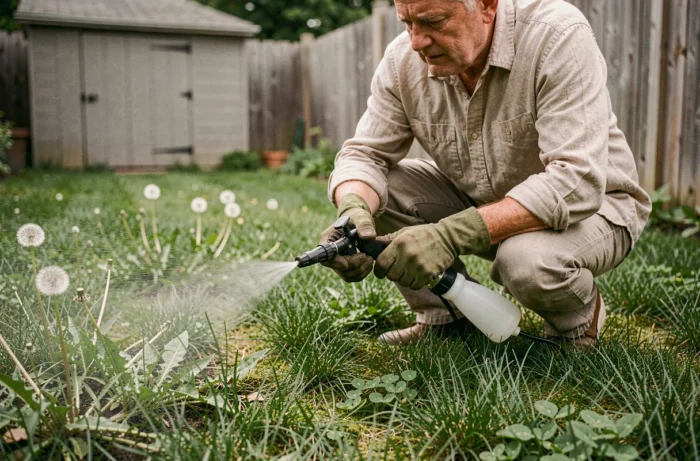
A selective treatment applied to freshly mowed grass loses a significant part of its effectiveness. The leaf surface area of weeds, the only real absorption zone for the product, determines the result much more than the seasonal timing. Here we detail the technical parameters that determine the appropriate sequence between mowing and spraying.
Plant cuticle and leaf penetration: the factor that mowing degrades
Selective herbicides for grass based on 2,4-D, MCPA, or dicamba penetrate the cuticle of weed leaves to then migrate to the root system. This cuticle, a protective waxy layer, varies in thickness depending on the age of the leaf and its exposure.
A mature leaf, not cut for several days, has a cuticle that is more permeable to the surfactants contained in the formulation. Conversely, a recent cut exposes less receptive scar tissue to the product. The cells undergoing repair absorb the active ingredient less effectively.
On rosette weeds (dandelion, plantain), mowing sometimes removes the majority of the useful foliage. The product then reaches a reduced surface area, insufficient for the absorbed dose to cause complete root destruction. We recommend allowing these weeds to develop sufficient foliage before any spraying, which implies delaying mowing.
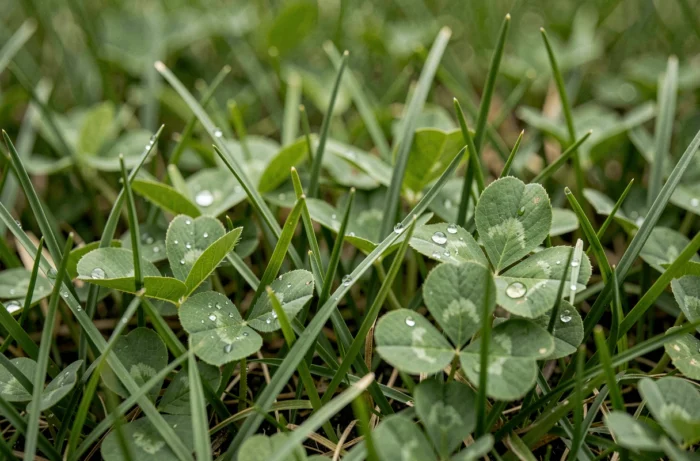
For creeping species like clover, the leaf loss after mowing is less, but the decrease in contact area still affects absorption. The principle remains the same: the larger the leaf surface at the time of treatment, the greater the effectiveness.
This mechanism is documented in several specialized resources, and you can learn more on the Clic Garden website to delve into the application sequences.
Delay between mowing and selective treatment: read the label before any empirical rule
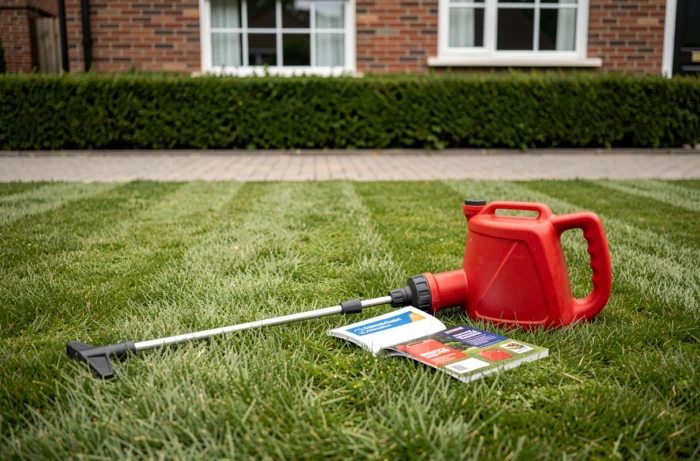
The common recommendation to respect a delay of a few days between mowing and application is not universal. Each formulation imposes its own timing constraints, noted on the product label and in the E-Phy sheet from Anses.
The E-Phy catalog lists authorizations, uses, doses, and untreated areas. It may also specify a re-entry interval (minimum time before entering the treated area) and distances from water. These regulatory constraints sometimes make treatment on a heavily trafficked lawn inappropriate, regardless of mowing timing.
A often overlooked point: the regulatory status of a product can change after purchase. An authorization withdrawn by Anses means that the product stored in the garage should no longer be used, even if it remains physically available. Checking the E-Phy sheet before each treatment campaign avoids this mistake.
Weather conditions and rain-free interval
The rain-free interval after spraying varies depending on the formulation. Some active ingredients require only a few hours of dry weather, while others require more. The product label remains the only reliable reference.
- Check the specific rain-free interval for the formulation used, not a generic rule.
- Control the re-entry interval, especially if the lawn is frequented by children or pets.
- Consult the E-Phy sheet on the Anses website to confirm that the product retains its market authorization.
Phytotoxicity on grasses: why mowing too soon after treatment burns the lawn
Mowing after selective treatment poses a symmetrical risk. An early mowing physically removes the product before complete absorption by the weeds. The product does not have time to penetrate the cuticle and ends up in the collection bin.
The second risk concerns the grass itself. The mower blades create micro-wounds on the grass blades. If residual product is still present on the surface, it penetrates through these wounds into the grasses, causing localized burns. This phytotoxicity phenomenon manifests as yellowed areas or patchy necrosis.
The least risky sequence consists of mowing a few days before treatment, then waiting at least the time indicated on the label before mowing again. This protocol allows the weeds time to redeploy their foliage after the first cut and ensures complete absorption before the next cut.
Mowing height as a preventive lever: reduce the need for selective treatment
The question “before or after mowing” masks an upstream parameter. Maintaining the grass at a height of 5 to 7 cm limits the germination of weeds by shading the soil. This height, higher than the short cut done by habit, reduces the need for selective herbicide in the long term.
A lawn mowed too short leaves the soil exposed to light, promoting the emergence of clover, speedwell, or dandelion. Raising the mower height is a measurable preventive action: over several seasons, weed pressure decreases significantly.
- Set the mower between 5 and 7 cm rather than below 4 cm.
- Favor regular mowing without removing more than one-third of the blade height at each pass.
- Combine this height with appropriate fertilization to densify the grass cover and limit colonizable spaces.
Fertilizers and selective treatment: do not overlap applications
Applying a lawn fertilizer and a selective herbicide on the same day overloads the soil and foliage. The fertilizer stimulates the growth of grasses, but also that of weeds. We recommend delaying the application of fertilizer by at least a week after the selective treatment, allowing the active ingredients to take effect on the undesirables.
Selective treatment on grass less than three months old is not recommended, even if mowing has already begun. Young grasses, still fragile, poorly tolerate active ingredients and react like the targeted weeds.
The appropriate sequence can be summarized in three steps: mow a few days before, spray on well-developed weed foliage, then wait the prescribed interval before the next mowing. The rest depends on the product label, not a general rule.