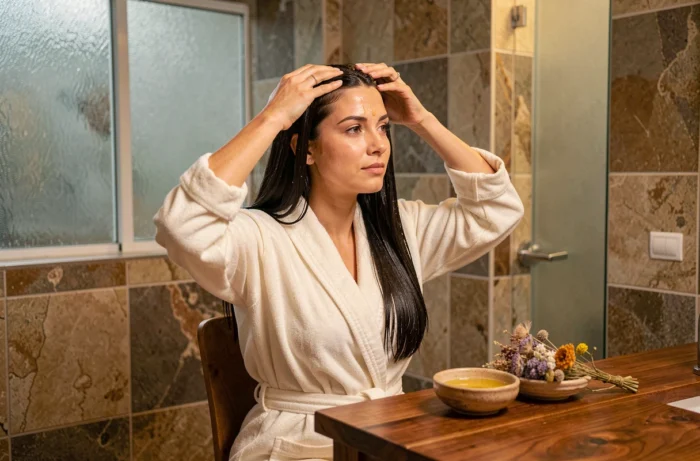
The hair charm bath refers to a gentle lightening technique, often confused with the light bath or American shampoo. What truly distinguishes these methods are their oxidizing dosages, their impact on the hair fiber, and the hair profiles to which they are suited. Comparing their technical parameters allows for the selection of the right service at the right time.
Charm bath, light bath, and American shampoo: what changes technically
These three terms circulate in salons without clear distinction. The table below gathers the criteria that separate them in practice.
| Criterion | Charm bath | Light bath | American shampoo |
|---|---|---|---|
| Base of the mixture | Tone-on-tone coloring + low oxidant | Diluted bleaching powder + low oxidant | Shampoo + bleaching powder + oxidant |
| Volume of oxidant | Generally low | Low to medium | Variable depending on dilution |
| Main objective | Revive shine, harmonize highlights | Slightly lighten the mass | Quickly lighten, remove excess color |
| Average application time | Short, often visually monitored | Short to medium | Very short |
| Risk on weakened hair | Moderate (controlled oxidation) | Higher if dosage is poorly calibrated | High if hair is already porous |
The charm bath is distinguished by a lower level of oxidation, making it suitable for a maintenance approach rather than a transformation. Its primary role is to revive the shine of an existing color without altering the base.
To explore this technique and its variations further, the hair charm bath on Beauté en Folie details several approaches based on hair needs.
Hair profiles compatible with the charm bath
The charm bath is not universal. Its effectiveness and tolerance vary depending on the condition of the fiber, the coloring history, and the sensitivity of the scalp.
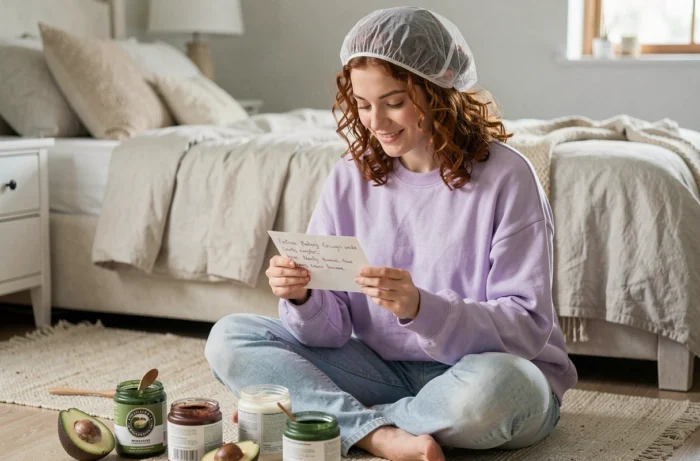
Colored or highlighted hair: the ideal ground
On hair that has received highlights or balayage, the charm bath serves to soften the visible demarcation between the regrowth and lengths. It re-harmonizes the highlights without adding a layer of permanent color.
Light brown and dark blonde hair benefit the most from this technique. The light oxidation enhances the already present golden highlights without turning yellow.
Profiles to avoid or frame
Some hair types react poorly to the charm bath, even at low dosage:
- Permed or relaxed hair has a fiber already weakened by chemical treatments, increasing the risk of breakage.
- A sensitive or reactive scalp may develop itching, redness, or a feeling of heat after oxidation.
- Very porous hair absorbs the mixture unevenly, resulting in a heterogeneous outcome with some areas lighter than others.
In these cases, a hair treatment without oxidant (nourishing mask with coconut oil, for example) is a safer alternative to revive shine.
Frequency and integration into a hair care routine
The question of frequency often arises. One application per month is the maximum recommended rhythm to preserve the fiber. Beyond that, repeated oxidation weakens the cuticle, even at low volume.
The charm bath does not replace regular moisturizing care. It fits into a routine as a one-off gesture, between two coloring or highlighting appointments.
Typical sequence to space out colorings
A reasoned routine can follow this logic:
- Coloring or highlights in the salon every two to three months, depending on the speed of regrowth.
- Charm bath midway to revive highlights and smooth the root-length transition.
- Gentle sulfate-free shampoo in between to limit color fading.
- Nourishing mask (oil, shea butter, or natural ingredients) once a week on the ends.
This sequence reduces the frequency of complete colorings, which limits chemical aggression in the long term.
Charm bath in salon or at home: differences in results
The charm bath can also be done at home with accessible products. However, the dosage of the oxidant remains the determining factor for the result, and this is where the gap widens between the two contexts.
In the salon, the stylist adjusts the volume of oxidant to the porosity of the hair, the thickness of the fiber, and the starting color. The application time is visually monitored, allowing the process to be interrupted as soon as the desired highlight appears.
At home, kits generally offer a standardized dosage. The main risk is not so much excessive lightening but an uneven result: the ends, being more porous, absorb more than the roots. An uneven result is the first sign of an inappropriate dosage.
For hair already sensitized by chemical treatments, going to the salon remains preferable. The stylist can also complement the charm bath with a gloss or an acid treatment that closes the cuticle scales, prolonging the hold of the highlights.
The hair charm bath remains a technical gesture before being a miraculous treatment. Its value lies in the precision of the dosage and in choosing the right moment to integrate it into a hair care routine. On compatible hair and with controlled frequency, it extends the lifespan of a color while limiting salon visits.