Converting grams to milliliters or translating a quantity into tablespoons is not simply a matter of a straightforward rule of three. The mass of an ingredient and the volume it occupies depend on a parameter often overlooked in traditional conversion tables: the density specific to each food. A tablespoon of honey does not weigh the same as a tablespoon of flour, even if the measured volume is identical.
Ingredient Density: The Factor That Tables Forget
Most conversion grids display fixed equivalences like “1 tablespoon = 15 ml”. This volumetric reference is correct for the container, but it says nothing about the actual weight of what it contains.
For water, the correspondence is direct: 15 ml weighs 15 g. Water serves as a reference because its density is 1. As soon as we deviate from this, the discrepancies widen. Oil, being less dense, gives about 13.5 g for the same spoon. Honey, significantly denser, exceeds 20 g.
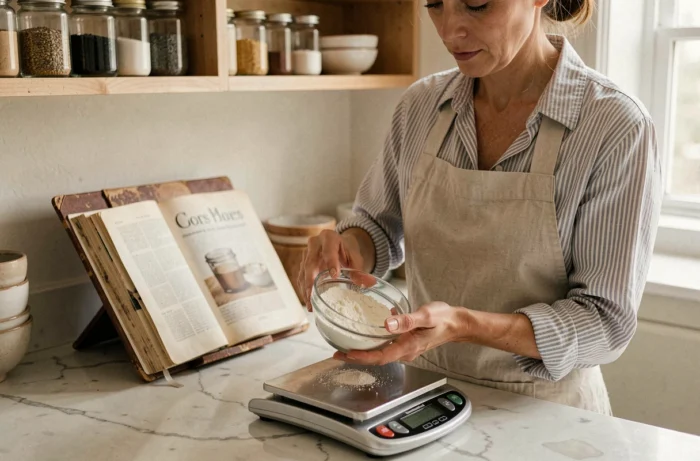
In baking, where precision determines texture, confusing mass and volume for flour or cocoa leads to noticeable errors. Packed flour in a spoon does not weigh the same as flour simply placed in it. To ensure the reliability of your recipes, consulting a weight converter on Double Portion allows you to quickly find the exact equivalence based on the ingredient.
The rule to remember: converting grams to milliliters requires knowing the density of the ingredient. Without this data, any conversion remains approximate.
Grams to Tablespoons Conversion: Reliable References by Ingredient
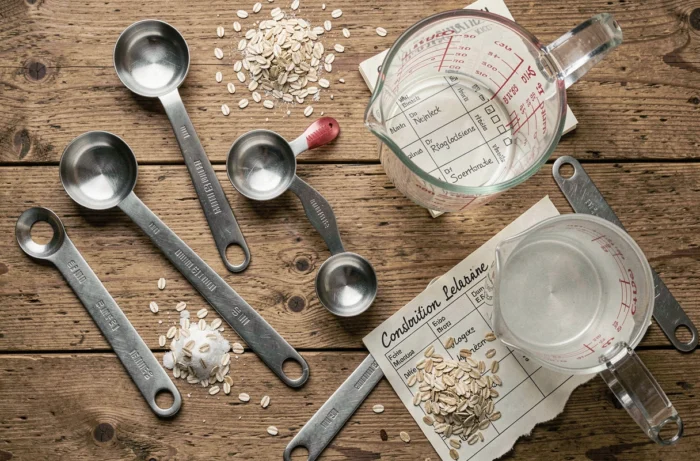
Rather than memorizing dozens of numbers, working by ingredient families simplifies everyday cooking. Here are the most useful references for a level tablespoon (15 ml in volume):
- Water, milk, vinegar: 15 g per tablespoon, as the density is close to 1
- Oil (olive, sunflower, canola): about 13.5 g, since fats are slightly less dense than water
- Flour, cocoa, cornstarch: between 9 and 11 g depending on packing, as these fine powders trap a lot of air
- Powdered sugar: about 12 to 13 g, denser than flour but less than water
- Honey, maple syrup: over 20 g, their high viscosity concentrates more material in the same volume
The teaspoon follows the same logic with a reference volume of 5 ml. Dividing the above values by three gives a consistent estimate.
Level or Heaped Spoon: A Difference That Changes the Recipe
A heaped tablespoon reaches 20 to 25 ml depending on the shape of the utensil. For a dry ingredient like flour, the difference between level and heaped can double the actual quantity. In baking, this difference is enough to alter the consistency of a dough.
The reliable technique is to fill the spoon without packing, then scrape off the excess level with the back of a knife. For fine powders (flour, cocoa), sifting beforehand avoids clumps that distort the measurement.
Small Volumes in Milliliters: Why Avoid Conversion to Grams
For measurements below 100 ml, staying in milliliters is often more reliable than converting to grams. The reason is arithmetic: with small quantities, density discrepancies take on a much larger relative proportion.
Take 10 ml of oil. The conversion gives about 9 g. The discrepancy with water (10 g) seems minimal, but it already represents 10% of the total amount. In a vinaigrette measured in teaspoons, this margin accumulates quickly.
A graduated measuring cup in milliliters remains the most suitable tool for these measurements. The graduations allow for direct reading of the volume without intermediate calculations. In the absence of a measuring cup, the following correspondence helps to navigate with common utensils:
- 1 teaspoon = 5 ml
- 1 tablespoon = 15 ml
- 1 standard mustard glass = about 200 ml
Adapting a Recipe Without a Scale: A Concrete Method
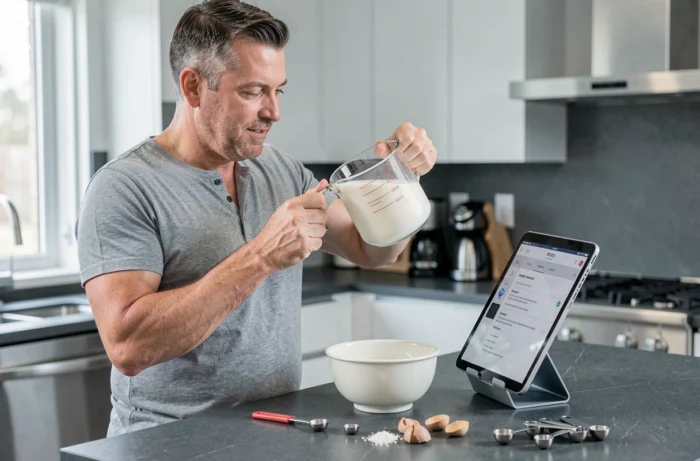
Not all kitchens have a precision scale. When the recipe indicates grams and only volumetric utensils are available, the conversion goes through two steps.
Identify the Nature of the Ingredient
Classify the ingredient into one of the families described above (aqueous liquid, fat, fine powder, dense powder, syrup). This classification determines the mass/volume ratio to apply.
Calculate the Number of Spoons Needed
Divide the required mass by the weight of a level tablespoon for that ingredient. For example, if a recipe calls for 50 g of flour and a level spoon contains about 10 g, you need to count 5 level tablespoons. For 50 g of oil, the calculation gives just under 4 tablespoons.
This method remains an approximation. The scale remains the most precise tool for baking, where a few grams of difference can alter the result. For everyday savory cooking, spoons offer sufficient precision as long as the level filling is respected.
One last technical point often overlooked: temperature slightly alters the density of certain ingredients. Melted butter does not weigh the same volume as cold butter cut into cubes. Measuring fats at room temperature stabilizes the results. For hot liquids (broth, warm milk), the variation remains negligible in home cooking.