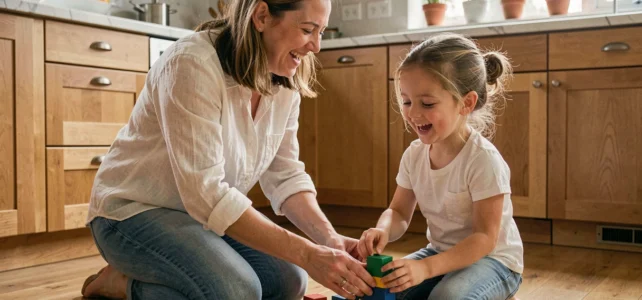
A child who refuses to put on their shoes in the morning, a meal that ends in negotiation, an evening where no one can find sleep. These scenes are common in most households. Being a fulfilled parent daily with their children does not rely on a single recipe, but on a few concrete adjustments that change the family dynamic.
Parental mental load: what the National Conference of 2026 highlights
The Ministry of Solidarity launched in February 2026 the National Conference on Parenting Support. The stated goal: to structure a framework to support parents, particularly regarding mental load and the balance between family life and professional life.
This official recognition changes the game. It means that parental fatigue is not a lack of will, but a structural phenomenon that public authorities are now taking seriously. The context of declining birth rates in France has accelerated this awareness.
In practical terms, this is also reflected in a new parental leave, created by the 2026 Social Security financing law, effective from July 1, 2026. This leave allows each parent with at least six months of affiliation to extend their presence with the child for up to two additional months.
The compensation reaches 70% in the first month and then 60% in the second. Additional resources are available on the maman-zen.fr website for parents, which addresses these daily parental support issues.

Regulating your own emotions before those of the child
Have you noticed that your child becomes more agitated when you are tense yourself? This is not a coincidence. Children pick up on the emotional state of adults and react like a mirror.
A calm parent has a direct effect on the child’s behavior. Not because they control themselves better, but because they reduce the ambient stress level. The opposite is also true: an exhausted parent who raises their voice triggers an almost automatic escalation.
Three gestures that help reduce pressure
- Leave the room for thirty seconds when anger rises, even if the situation is unresolved. This pause breaks the cycle of reactivity and allows for a more measured response.
- Name what you feel out loud in front of the child (“I am annoyed, I need a minute”). This verbalization models emotional management better than any theoretical explanation.
- Identify the time of day when patience collapses (often between 5 PM and 7 PM) and plan a low-energy activity for that time slot, such as a short cartoon or a quiet game.
This personal regulation has nothing to do with perfection. It involves recognizing your own warning signals and acting before overflowing.
Screens and parental stress: the link confirmed by research
A study reported by Earth.com shows that stressed parents are more likely to use screens to manage young children. The reflex is understandable: a tablet buys immediate silence.
The problem is not the screen itself, but the screen used as the only pressure relief valve. When it becomes systematic, it masks a need for support that the parent is not getting elsewhere. This is where the “support village” (grandparents, neighbors, friends, associations) makes all the difference.
Rather than feeling guilty about screen time, ask yourself this question: do I have at least one concrete alternative when I am at my wit’s end? If the answer is no, the real issue is not the tablet, it’s the isolation.

Positive parenting in daily life: concrete guidelines rather than abstract principles
Positive parenting sometimes suffers from its image. It is perceived as an unattainable ideal where the parent never says no and remains smiling under all circumstances. In practice, it relies on simple mechanisms.
Describe what you see rather than judge. For example, say “you spilled your glass, take the sponge” instead of “you always mess things up.” The first sentence directs towards action. The second attacks the child’s identity and provokes closure.
The evening routine as a connection lever
The bedtime moment often concentrates the tensions accumulated throughout the day. Three simple elements transform this period:
- A time of physical contact without words (hug, foot massage, hand in hair) that lowers cortisol levels in both the child and the parent.
- A specific question rather than “how was your day?”. For example: “what was the funniest moment today?”. Targeted questions generate richer responses and open a space for real dialogue.
- A short and identical ritual every evening (song, story, repeated phrase). Predictability reassures the child’s brain and facilitates falling asleep.
These habits do not require training. They require consistency, which is both simpler and more challenging than it seems.
Work-life balance: making choices without guilt
The new parental leave of 2026 marks a turning point in how French society perceives the work-family balance. Accessible to every parent, it recognizes that parental presence in the early months has measurable value for the child’s development.
Beyond this provision, the daily challenge remains the same: how to be present when you are there. A parent who comes home from work and spends twenty minutes fully available (phone off, focus on the child) has a greater impact on the relationship than a parent who is physically present but absorbed by their messages.
The quality of time spent together depends less on the number of hours than on the real attention given. This is a parameter that every parent can control, regardless of their professional constraints.
Building a fulfilling family daily life rarely involves major changes. A named emotion, a maintained evening ritual, a moment of true presence after work. These micro-adjustments, repeated over weeks, ultimately change the atmosphere of a home far more sustainably than an exceptional weekend.