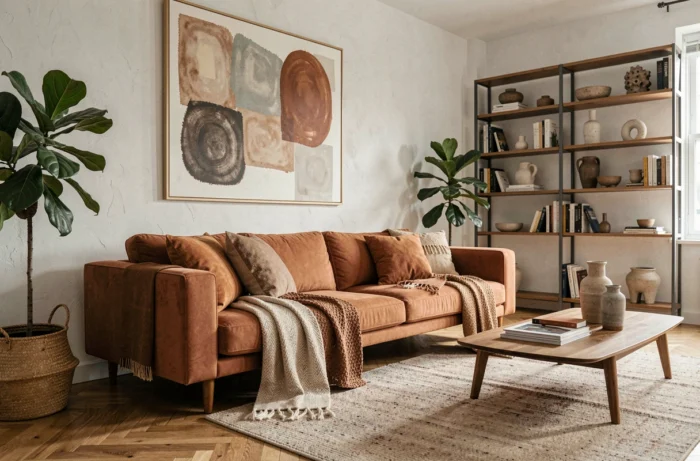
Interiors are evolving towards cleaner lines, tactile materials, and a search for functionality that goes beyond mere aesthetics. Home decoration in 2026 is no longer just about choosing a wall color or a trendy sofa. It responds to daily uses that have become hybrid, between remote work, family life, and the need for calm.
Raw and bio-sourced materials: what interior decoration borrows from construction
Raw travertine on a coffee table, recycled hemp in a cushion, bio-sourced wax around a light fixture: these materials, long confined to construction or craftsmanship, are migrating to furniture and decorative accessories. The trend is not limited to a visual effect. It relies on a texture that is perceptible to the touch, an irregular grain, a matte surface that absorbs light instead of reflecting it.
Certified or recycled wood remains the foundation of this approach, but designers are now pairing it with bio-sourced filaments for pendants and with corduroy or boucle for seating. Several references presented at the Maison et Objet 2026 fair combined a raw wood base with a seat in recycled textile, without a lacquered finish.
To explore ideas that showcase these materials piece by piece, the Pop Shot home site gathers regularly updated selections.
The interest in these materials goes beyond style. Linen, hemp, and travertine age without going out of fashion, which reduces the replacement rate. However, feedback on the ground diverges regarding the stain resistance of travertine in daily use, particularly on a kitchen backsplash. A water-repellent treatment is often necessary, which diminishes the argument for “pure raw.”
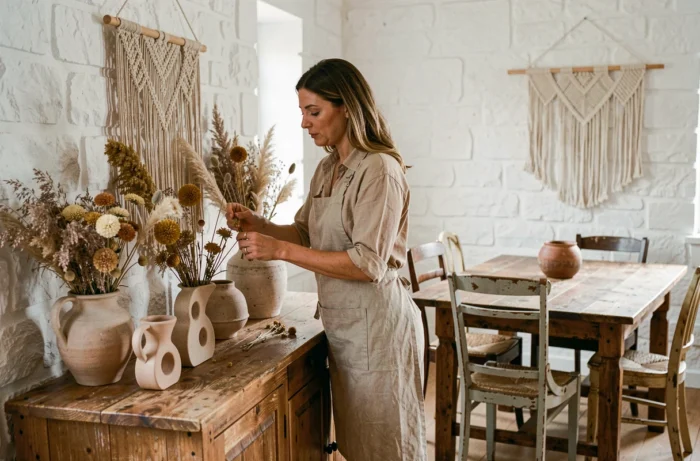
Warm minimalism: decorating less to decorate better
Warm minimalism has been structuring interiors since late 2025. The principle is encapsulated in one constraint: reduce the number of pieces of furniture and objects, but choose each for its form, material, and versatility.
In practice, this results in spaces where a sofa with organic curves replaces a sofa set with armchairs and a pouf. An extendable table with integrated storage serves as both a dining table and a desk. Multifunctional sculptural furniture absorbs multiple uses within a single volume.
What warm minimalism changes in color choices
Palettes narrow around muted shades: muted terracotta, rosy beiges, matte browns. Matte paint dominates because it hides surface imperfections and enhances the enveloping effect. Plant-patterned wallpaper, especially foliage, returns in bedrooms and entries as a textured counterpoint to these neutral flats.
The absence of bright colors does not mean a bland interior. Contrast is created by materials: a lime-coated wall facing a dark wood piece of furniture, a thick wool rug on a waxed concrete floor. Relief replaces color as a decorative tool.
Modular furniture and hybrid pieces: adapting the home to daily life
Sustainable remote work has changed the geometry of homes. A single room serves as a living room in the evening, an office during the day, and sometimes a gym early in the morning. Home decoration incorporates this constraint through modular furniture.
Manufacturers now offer ranges designed for these transitions:
- Storage sofas with seats that lift to store a computer, cables, and files at the end of the workday
- Foldable desks fixed to the wall, which fold down into a decorative console once the day is done
- Coffee tables with lift tops, which transition from coffee table height to dining height without moving any furniture
This furniture is not a gimmick. It responds to a real space constraint in urban apartments. Each piece of furniture must justify the space it occupies by at least two functions.
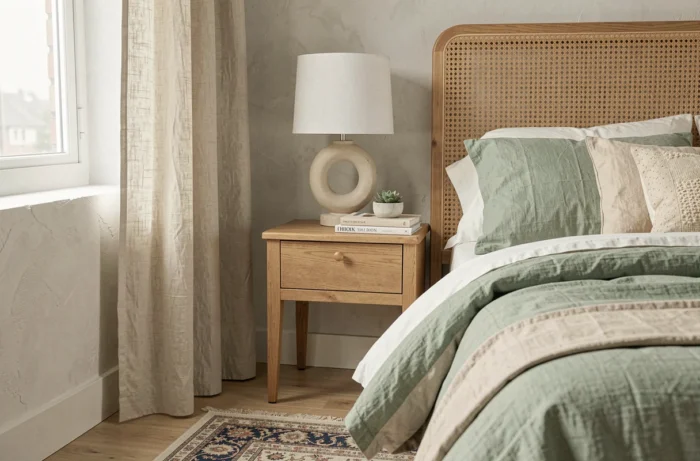
Wall decoration and decorative objects: the place of the superfluous
In a clean interior, every visible object carries more weight. A poorly chosen vase or a generic frame disrupts the balance of an entire room. Current trends favor decorative objects made from raw materials (handcrafted ceramics, blown glass, patinated metal) in limited numbers.
Mirrors maintain their role of visual enlargement, but their frames are changing. Models with irregular edges, made from reconstituted stone or carved wood, replace standardized gilded frames. The idea is not to eliminate wall decoration but to treat it as a deliberate choice rather than mere filling.
Revisited Art Deco and geometric patterns: the return of a style in the home
The Art Deco style, characterized by sharp geometric lines and noble materials, is resurfacing in the collections for the fall of 2026. The curves of warm minimalism coexist with angular patterns on textiles, wallpapers, and certain accent furniture.
This return does not replicate the Art Deco of the 1930s exactly. It retains the graphic structure (arches, chevrons, symmetries) while applying it to contemporary supports: a vinyl floor with geometric patterns, wallpaper in an alcove, cushions with architectural prints.
- Geometric patterns work by zones: one wall, a nook, a corridor section, never the entire room
- Colors remain in the matte and muted range, avoiding the “showroom” effect
- Associated furniture remains understated to avoid visual competition with the pattern
A strong pattern works on a limited surface. Applied everywhere, it saturates the space instead of structuring it.
Home decoration in 2026 is built through subtraction as much as addition. Choosing a raw material, a multifunctional piece of furniture, or a targeted geometric pattern produces a more readable result than an accumulation of trends. Coherence between materials and uses takes precedence over the number of decorative objects.